How to brief an AI ad studio: what to send for better ads
Short answer: Send one clear offer, a specific audience, proof you can actually show, your logo, fonts, colours and real product footage, a short do and don't list, the formats and platforms you need, and any legal lines. A one-page brief with these items gets better first drafts and fewer revision rounds.
Why does the brief matter so much with AI ad studios?
AI tools make versions quickly, but they only remix what you give them. A vague brief produces fast, polished ads that say nothing.
A clear brief does three jobs. It tells the studio what to sell, to whom, and what it must never show. Everything else is craft.
New to this kind of work? Our guides to AI video ad costs in India and AI UGC-style ads explain what studios make.
What should a brief include?
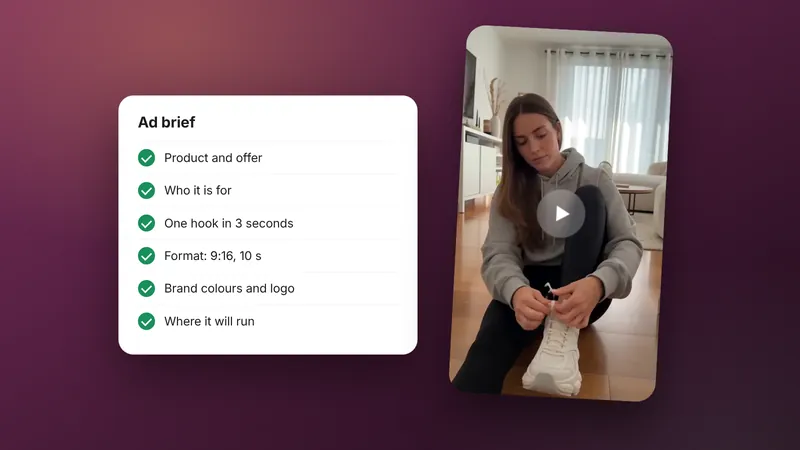
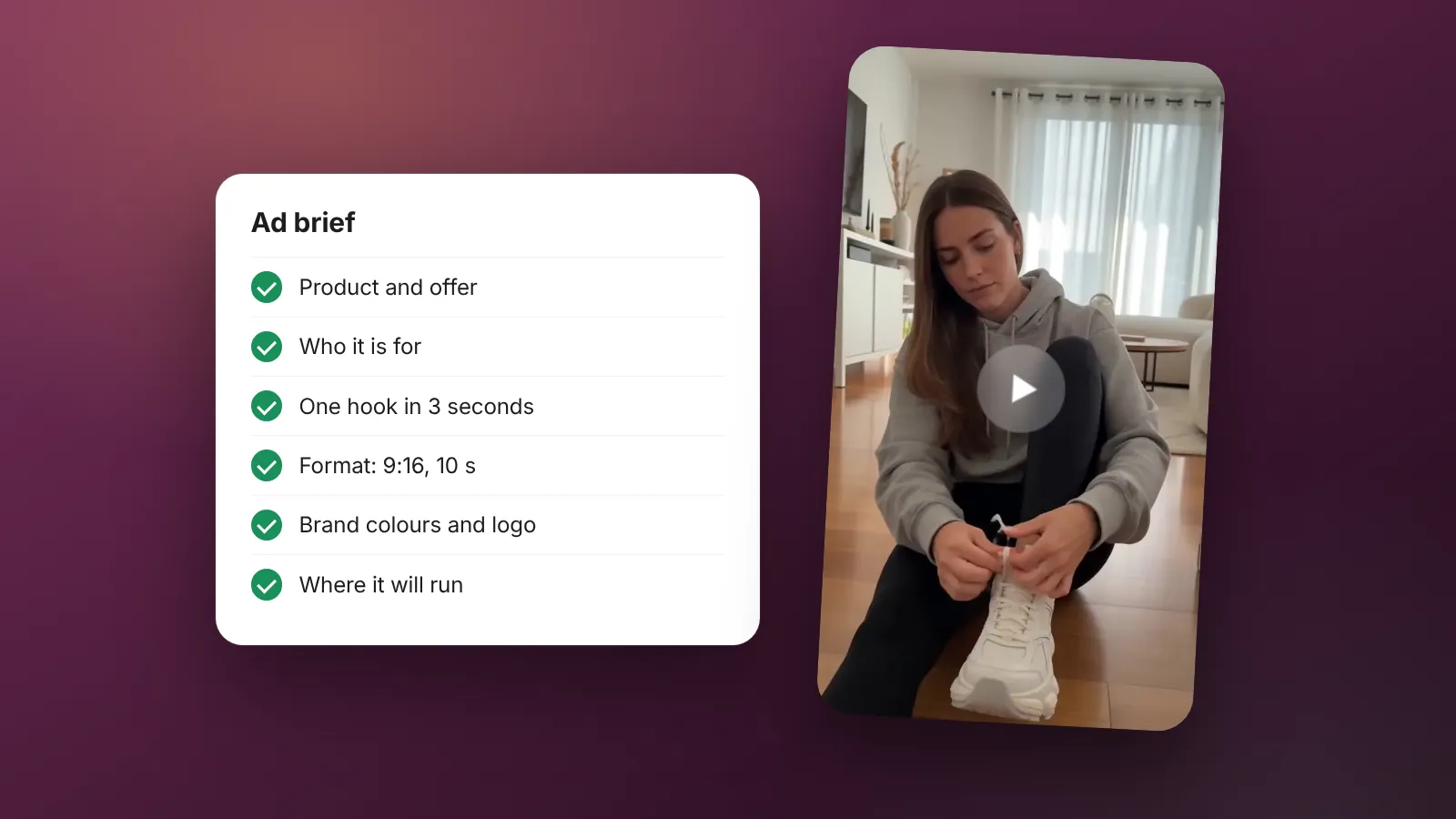
Eight items cover almost every campaign. Use this as your checklist.
- The offer. One thing you want people to do, at a clear price or benefit.
- The audience. Who they are, what they worry about, and what they already know.
- Proof you can actually show. Real reviews, real numbers, real awards, real photos.
- Brand assets. Logo files, fonts, colours, product photos and raw footage.
- Do and don't. Words, visuals and claims that are in or out.
- Formats. Sizes and lengths you need.
- Platforms. Where the ads will run.
- Legal lines. Disclaimers, registration numbers or terms that must appear.
Start with one offer
Pick one offer per brief. "Weekend stay with breakfast from ₹6,999" is an offer. "Luxury, family-friendly, great food and spa" is a list of features.
Describe one audience
Write two or three lines about the person you want to reach. Include what stops them buying. Objections make the best hooks.
What counts as proof you can show?
Only proof that is real and that you can point to. If you cannot back it up, leave it out of the brief.
Good proof includes a review you have permission to quote, a real rating from your own listing, a genuine award, or a real before-and-after. Bad proof includes invented testimonials, made-up statistics and AI-generated people presented as real customers.
AI-made people and scenes should never be passed off as genuine customers or real results. Label AI-made creative honestly. Our post on whether AI-generated ads are allowed on Facebook and Instagram covers the platform side.
What brand assets should you send?
Send real files, not screenshots. The better the inputs, the closer the ads look to your actual product.
- Logo in vector or high-resolution transparent format.
- Brand colours as codes, and font names or files.
- Real product photos from several angles.
- Raw phone footage of your space, team or product in use.
- Two or three past ads that worked, and one that did not.
- Ads from other brands you like, with a note on why.
Real footage matters most. AI can change backgrounds, add motion and make variations. It should not invent your room, dish or product.
Which formats and platforms should you list?
List every placement you plan to use, so the studio frames shots correctly from the start. Re-cropping later often cuts off text or faces.
| Placement | Shape | Notes for the studio |
|---|---|---|
| Instagram and Facebook Reels | Vertical 9:16 | Keep text away from the bottom and sides |
| Instagram and Facebook feed | 4:5 or 1:1 | Hook must work without sound |
| Stories | Vertical 9:16 | Leave room for the reply bar |
| YouTube Shorts | Vertical 9:16 | Similar to Reels, check text placement |
| Google display and Performance Max | Several sizes | Send square, landscape and portrait versions |
| ChatGPT ads | Check current specs | Confirm formats in the platform before briefing |
ChatGPT ads are a newer option. As of October 2026, OpenAI describes them as labelled sponsored placements shown below answers to adult users on the Free and Go plans. CNBC reported on 21 October 2026 that they are available in 89 countries, including the US, the UK, Canada, Australia and India.
What should go in the do and don't list?
Keep it short and specific. Ten lines is plenty.
Useful "do" lines: always show the real product, use our brand colours, include the price in the first three seconds. Useful "don't" lines: no competitor names, no slang, no images of alcohol, no claims about health results.
Also include any words your legal or compliance team has already ruled out. That saves a full revision round.
What does a brief template look like?
Copy this table, fill in each row, and send it with your files.
| Field | What to write | Example |
|---|---|---|
| Offer | One action and one price or benefit | Weekend stay with breakfast from ₹6,999 |
| Audience | Who, where, what stops them | Couples in Mumbai and Pune who worry about long drives |
| Proof | Real items only, with links or files | Screenshot of our real rating from our own listing |
| Assets | Files attached | Logo, fonts, 40 room photos, 6 phone clips |
| Do | 3 to 5 lines | Show the real pool, mention breakfast, use our teal |
| Don't | 3 to 5 lines | No crowded beach shots, no stock couples |
| Formats | Shapes and lengths | 9:16 Reels up to 20 seconds, 4:5 feed |
| Platforms | Where it runs | Instagram, Facebook, YouTube Shorts |
| Legal lines | Exact wording | Prices per room per night, taxes extra, subject to availability |
| Goal and budget | Result to track, rough spend | WhatsApp enquiries, about ₹1,500 a day to test |
Worked example (example numbers): A boutique hotel sends the brief above for a 7-day sprint.
It asks for 10 ads: 4 Reels, 3 feed ads and 3 Stories.
That is 4 + 3 + 3 = 10 ads.
The studio builds 3 hooks from the brief: the drive time, the breakfast and the pool at sunset.
The hotel tests all 10 at ₹1,500 a day for 7 days, a total test spend of ₹10,500.
After the test, it pauses the weakest ads and keeps the best hooks for the next round.
These are example numbers to show the maths, not a benchmark for your results.
How do you give feedback on the first drafts?
Judge drafts against the brief, not against personal taste. Ask whether each ad shows the offer, speaks to the audience and follows the do and don't list.
Collect all comments in one document. Mark each note as "must fix" or "nice to have". Then let the ads run and let results, measured as leads and cost per lead, settle the debates.
The WebMaxs AI ad studio Creative Sprint is a one-time $490 or ₹24,999 for 10 ready-to-run ads in 7 days. Monthly plans that include more creative are on our pricing page.
Frequently asked questions
How long should a brief be?
One or two pages is enough for most campaigns. Long briefs bury the important parts. If you have more detail, attach it as reference files and keep the brief itself short.
Can the studio work from just our website?
It can start there, but results are better with real photos, product footage and your brand files. A website shows what you say about yourself. Raw footage shows what you actually look like.
How many revision rounds should I expect?
Agree this before work starts. A clear brief usually means fewer rounds. Collect all feedback from your team in one message, rather than sending notes one person at a time.
Who owns the ads once they are made?
Agree usage rights in writing. Ask whether you can run the ads on any platform, for how long, and whether any music, voices or stock elements have limits. Keep the final files in your own storage.
Should we tell the studio our ad budget?
Yes, roughly. Budget affects how many versions are worth making and testing. A small budget is better spent on a few strong ideas than on many variations nobody sees.
Sources
- OpenAI: New ways to buy ChatGPT ads (5 May 2026)
- CNBC: OpenAI ChatGPT ads expand to more countries (21 October 2026)
Platform rules change. Check the official pages before you launch.
Want this done for your brand?
See how WebMaxs handles the AI Ad Studio, or tell us about your business and we will bring three ideas and a free sample ad to the call.