MVP app cost in Australia vs offshore development

Short answer: MVP cost depends on scope, platforms, design, back-end work and who builds it. Australian teams cost more per hour but sit in your time zone. Offshore teams cost less per hour but need clear specs, strong communication and IP protection. A hybrid, with local project management and offshore development, often balances the two.
What does an MVP app cost in Australia?
It depends on scope and who builds it. There is no fair single number, because an MVP can be a simple booking tool or a two-sided marketplace.
Published guides help you see the spread. One Australian agency's 2026 guide sets out what an MVP can cost locally. Clutch's pricing guide publishes developer rates, including for the US and Australia. Figures change, so read both pages directly. Treat them as agencies and directories publishing ranges, not as a quote for your app.
So skip the question of what an app costs. Ask what your MVP needs, and which team gives the best result for that money.
What should an MVP actually include?
Only the features needed to test your core idea with real users. Everything else goes on a "later" list.
A good MVP answers one question, such as "will gym owners pay for automated class reminders?". To answer it, you usually need:
- Sign-up and log-in.
- The one core action users came for.
- A simple admin view so you can see what is happening.
- Basic analytics, so you can measure use.
- Payments, only if paying is part of the test.
Leave out social features, complex settings and multiple user roles unless the test depends on them.
What drives the cost of an MVP?
Scope drives most of it, then design, back-end work and team location. Here are the main levers.
| Cost driver | Lower cost choice | Higher cost choice |
|---|---|---|
| Platforms | One platform, or one cross-platform codebase | Separate native iOS and Android apps |
| Features | Three to five core features | Many features, roles and settings |
| Design | Clean, standard components | Fully custom interface and animation |
| Back end | Managed services and simple database | Custom servers, real-time features, heavy data |
| Integrations | Few, well-documented services | Payments, maps, chat, legacy systems |
| Team location | Offshore or hybrid | Fully onshore in Australia |
| Process | Clear spec and fast feedback | Changing requirements mid-build |
How does an Australian team compare with offshore and hybrid teams?
Each option trades cost against convenience and control. The table below compares them on what usually matters most.
| Factor | Onshore (Australia) | Offshore | Hybrid (local PM, offshore build) |
|---|---|---|---|
| Hourly cost | Highest | Lowest | In between |
| Time zone | Same as you | Partial overlap, depending on country | Local contact in your hours |
| Communication | Easy, face-to-face possible | Needs written specs and set meeting times | Local PM translates and chases |
| IP and contracts | Australian law, familiar terms | Needs careful contracts and account control | Contract with a local entity possible |
| Quality control | Direct oversight | Depends on process and testing | PM owns acceptance testing |
There is no universally right answer. A founder with a clear spec and time to manage may do well offshore. A founder who is busy selling may value a local project manager more than the hourly saving.
How do time zones and communication work with an offshore team?
They work if you plan for them. Problems usually come from unclear specs, not from distance itself.
India, for example, is several hours behind eastern Australia, so mornings in India overlap with afternoons in Sydney. That leaves a daily window for a short call. The rest can run on written updates.
What helps:
- A written spec with acceptance criteria for each feature.
- One fixed daily or alternate-day check-in in the overlap window.
- A shared task board you can see at any time.
- A demo of working software every week or fortnight.
- One named person on each side who makes decisions.
How do you protect your intellectual property offshore?
Through contracts and account control, set up before any code is written. Get advice from an Australian lawyer on the contract itself.
Practical steps that do not depend on trust:
- IP assignment: the contract should assign all code, designs and content to your company.
- Code in your account: keep the code repository in your company's account, with developers added as members.
- Your accounts: app store, cloud hosting and domain accounts in your company's name.
- NDA: sign one before sharing anything sensitive.
- Regular handover: ask for documentation and deployment steps as you go, not at the end.
If you hold the accounts and the code, you can change teams without starting again.
How do you keep quality high, whoever builds it?
Define "done" before work starts, then test against it. Quality comes from process more than from location.
Ask any team, local or offshore, how they handle code review, automated tests and staging releases. Ask to see a live app they built, and try it on your own phone. Do a small paid first milestone before committing to the full build.
Worked example (example numbers): suppose an MVP is estimated at 600 hours of development and 80 hours of project management.
Option A, fully onshore, at an example rate of A$150 an hour: 680 x 150 = A$102,000.
Option B, hybrid: 600 build hours at an example A$50 an hour is A$30,000.
Add 80 local PM hours at A$150, which is A$12,000, for a total of A$42,000.
Now add a 20% buffer to each for changes: A$122,400 for Option A and A$50,400 for Option B.
These rates and hours are example numbers to show the maths, not quotes or market averages.
The gap looks large, but check what each option includes. Rework from a weak spec can eat into any saving, so the hybrid only wins if the spec and testing are solid.
Where do WebMaxs and CodeGenIT fit in?
Apps are built by our development partner CodeGenIT, which already builds for clients in Australia. WebMaxs looks after the marketing side, such as launch ads, landing pages and tracking.
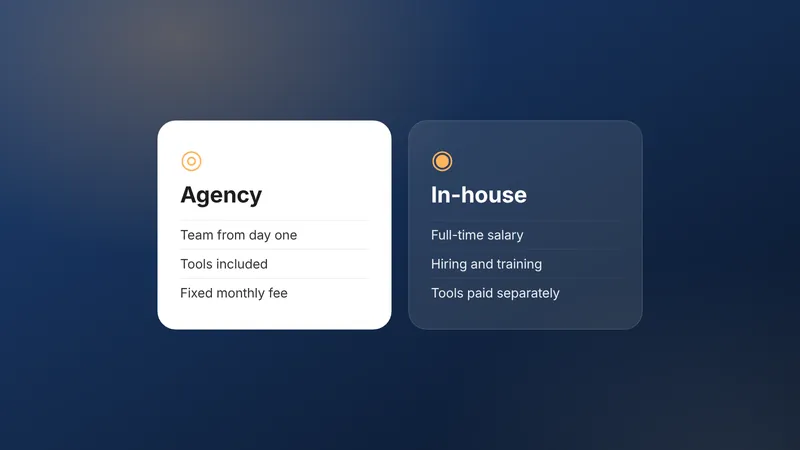
App projects are fixed-price, quoted after a free scope call. See the apps service page for what is covered, and our Australia page for how we work with Australian businesses. If you are also weighing up a website, our post on website costs covers the same cost drivers. For deciding what to keep in-house, see agency vs in-house.
Our monthly marketing plans are listed separately on the pricing page, for when the app is ready to promote.
Frequently asked questions
Should I build for iOS and Android at the same time?
Not always. Many MVPs start on one platform, or use a cross-platform framework to cover both from one codebase. Pick based on where your first customers are, then expand once the idea is proven.
Is a no-code tool enough for an MVP?
It can be, for testing demand with simple screens and forms. It becomes limiting when you need custom logic, scale or integrations. Plan how you would move off it if the MVP works.
What should I have before I ask for quotes?
A one-page brief: the problem, the user, the three to five core features, and what success looks like after launch. Add rough wireframes if you can. Quotes based on a clear brief are far easier to compare.
Who should own the app store accounts?
Your business should. Set up the Apple and Google developer accounts in your company's name, then add the developers as team members. That way you never need to ask anyone for permission to update your own app.
How do I avoid scope creep on an MVP?
Write down what is out of scope as clearly as what is in. Keep a 'later' list for good ideas that come up during the build. Only move something into the MVP if something else of similar size moves out.
Sources
- Appomate: How much does an MVP app cost in Australia? 2026 guide (22 August 2026)
- Clutch: Web developer pricing guide
Platform rules change. Check the official pages before you launch.
Want this done for your brand?
See how WebMaxs handles apps, or tell us about your business and we will bring three ideas and a free sample ad to the call.