Performance marketing agency vs in-house marketer: the real cost in India
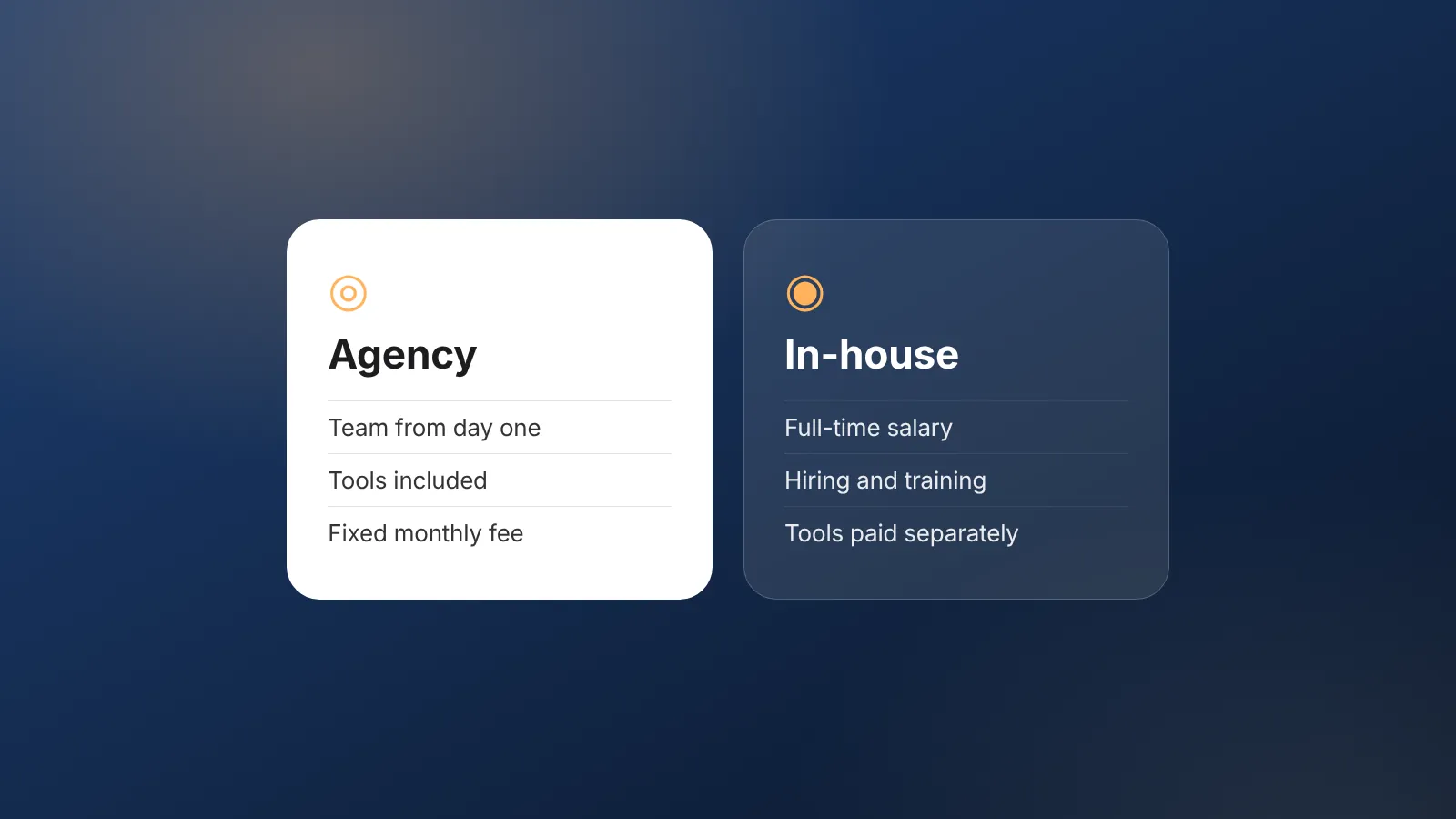
Short answer: An in-house marketer costs more than a salary. Add tools, creative, your management time, hiring and cover for leave. An agency fee often bundles these, but knows your business less deeply. In-house usually wins at high, steady spend with daily needs; an agency often suits smaller teams needing several skills.
What are you really comparing?
You are comparing the full monthly cost of results, not a salary against a fee. Both options need ad spend, creative, tools and someone's time to manage them.
The ad spend itself is the same either way. It goes to Meta, Google or other platforms from your own account. What differs is everything around it.
So list every cost line for both options before you decide. Then add the things money does not show: speed, depth of knowledge and risk.
What does an in-house marketer cost beyond salary?
Salary is the biggest line, but rarely the only one. Tools, creative support, hiring time and leave cover add up.
Salaries vary widely by city, experience and channel mix. We have not cited a market figure here. Check current job listings for your city and the level you need.
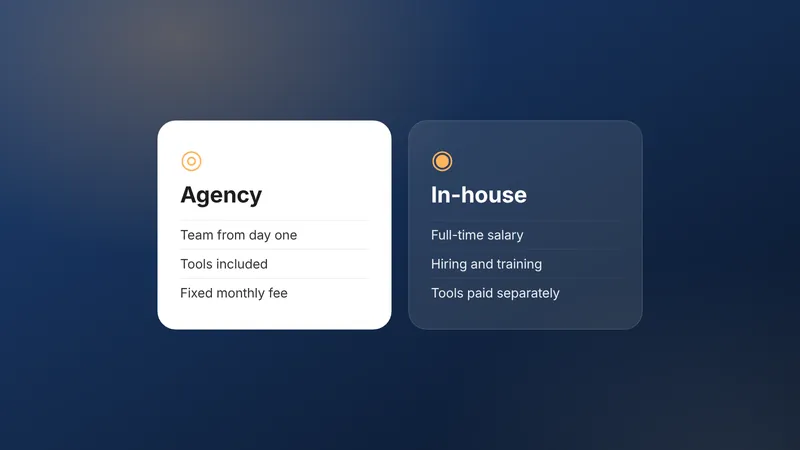
| Cost line | In-house marketer | Agency |
|---|---|---|
| Salary or fee | Monthly salary plus benefits and any bonus | Monthly fee |
| Tools | Analytics, design, scheduling and reporting tools you pay for | Usually covered by the agency |
| Creative | Designer or video editor, in-house or freelance | Included up to a set number, depending on plan |
| Your management time | Weekly direction, reviews and approvals | Usually less, mostly reviews and a regular call |
| Hiring and training | Recruiting time, notice periods, onboarding | Onboarding call and a one-time setup |
| Cover for leave or exit | Campaigns can stall when the person is away or leaves | Usually covered by the wider team |
| Depth of business knowledge | High, works inside the business daily | Lower, depends on how well you brief them |
The last line matters. An in-house person hears customer calls, sits in sales meetings and knows the product. That knowledge often shows up in better ads.
What does an agency cost?
Agency fees in India vary with scope. Some agencies charge a flat monthly fee, some take a percentage of ad spend, and some mix a fixed fee with a bonus.
Compare quotes on what is included. Ask how many new ads you get each month, how often you get a report, and who you speak to.
For reference, WebMaxs plans are fixed monthly fees. Essentials is ₹50,000 a month and Launch Growth is ₹75,000 a month. Full Funnel is ₹1,25,000 a month. There is a one-time setup of ₹25,000, and ad spend is always separate. Details are on our pricing page.
How do the totals compare?
Add every line for a full year, including one-time costs. The worked example uses example numbers only, not market rates.
Worked example (example numbers): A business compares one in-house marketer with an agency on a ₹75,000 monthly plan.
In-house, for example: salary ₹60,000, tools ₹8,000, a freelance designer ₹25,000 and recruiting costs spread at ₹5,000 a month.
The owner spends about four hours a week managing, valued at ₹10,000 a month.
In-house total: ₹60,000 + ₹8,000 + ₹25,000 + ₹5,000 + ₹10,000 = ₹1,08,000 a month, or ₹12,96,000 a year.
Agency: ₹75,000 × 12 = ₹9,00,000, plus ₹25,000 setup and one hour a week of owner time at ₹2,500 a month.
Agency total: ₹9,00,000 + ₹25,000 + ₹30,000 = ₹9,55,000 a year.
Ad spend is the same in both cases and is left out.
Your own numbers could reverse this. A lower salary, free tools or an in-house designer already on staff would change the result. Run the sum with your real figures.
Cost is also only half the question. The cheaper option is no bargain if it brings fewer customers.
When is in-house the better choice?
In-house is often better when your ad spend is high and steady, and you need someone inside the business every day. Strong product knowledge and fast internal decisions favour it.
Signs that in-house suits you:
- You run many campaigns across products that need daily attention.
- Your product is complex, and good ads depend on deep knowledge of it.
- You already have designers, a CRM owner and analytics support in-house.
- You want marketing skills to stay inside the company for the long term.
Some businesses use both: an in-house lead who sets direction, plus outside specialists for specific channels or creative.
When is an agency the better choice?
An agency often suits smaller teams that need several skills, such as ads, creative, tracking and reporting, but not several full-time hires.
Signs that an agency suits you:
- Your ad spend does not yet justify a full-time salary plus tools.
- You need creative made every month, not just campaigns run.
- You do not have time to manage a marketer each week.
- You cannot afford campaigns stalling during someone's leave or notice period.
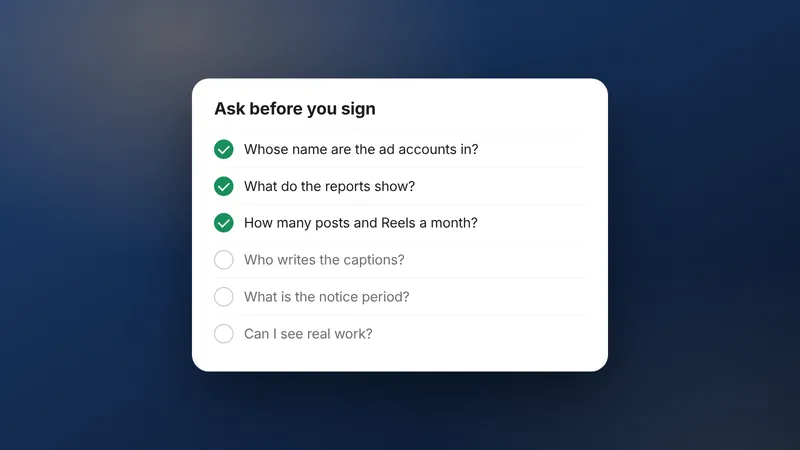
Whichever you choose, keep the ad accounts in your own name. Our post on questions to ask before hiring a social media agency has a checklist.
Can one person keep up with every channel?
It is hard. Performance marketing now covers Meta, Google, tracking, creative testing and, more recently, AI-led channels.
ChatGPT ads are one example. They launched in India in late August 2026, according to Outlook Business. The self-serve Ads Manager opened to Indian advertisers from 4 September 2026, with daily budgets from ₹725, as of October 2026, according to Manifest.
A single in-house hire must learn each new channel alongside their daily work. A team spreads that learning across several people. Neither guarantees results, but plan for the learning time either way.
Is a hybrid model worth considering?
Often, yes. Some businesses keep strategy and customer knowledge in-house and use outside help for execution or creative.
A common split looks like this:
- An in-house owner or marketing lead decides goals, offers and budgets.
- An agency or freelancer runs campaigns and produces creative.
- The in-house person reviews reports and feeds back what sales are hearing.
This keeps knowledge inside the business without hiring for every skill. Our post on agency, freelancer or in-house for Instagram compares the options for social media.
If you want outside help with paid campaigns, see our performance marketing service.
Frequently asked questions
Is a freelancer a cheaper middle option?
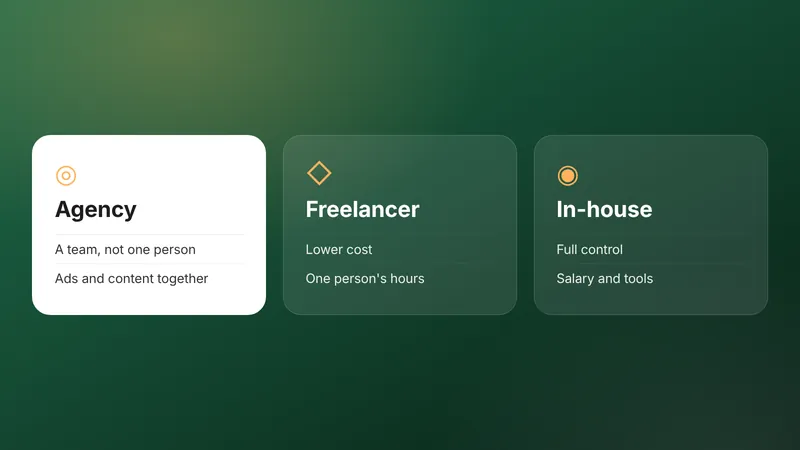
Often, for one channel and a limited scope. A good freelancer can run Meta ads well. Check who covers creative, reporting and leave, because one person still has the same gaps as one employee.
How long does it take an in-house hire to get up to speed?
Expect some weeks to learn your product, customers and past data before results settle. Budget for that period as part of the cost. An agency also needs onboarding time, though usually with set processes.
Who should own the ad accounts?
Your business, always, whether you hire in-house or use an agency. Give people access through your own business account. Then nothing is lost if someone leaves.
Can we switch from an agency to in-house later?
Yes. If the accounts, pixel and reports are in your name, the handover is simple. Ask the agency to document what is running and why before the switch.
Should a startup hire a marketer before it has product-market fit?
Usually not a full-time performance marketer. Early on, small tests to learn what message and channel work are often enough. Hire for scale once you know what you are scaling.
Sources
- Manifest: OpenAI launches ChatGPT ads in India (2026)
- Outlook Business: OpenAI rolls out ChatGPT ads in India (2026)
Platform rules change. Check the official pages before you launch.
Want this done for your brand?
See how WebMaxs handles Performance marketing, or tell us about your business and we will bring three ideas and a free sample ad to the call.