Why your Meta ads stopped working: creative fatigue explained
Short answer: Creative fatigue happens when the same people see the same ads too often and stop responding. Frequency rises, click-through rate falls and cost per result climbs. Check that nothing else changed, then add new creative on a steady schedule and test new ideas in a simple, separate structure.
What is creative fatigue?
Creative fatigue is when an ad that worked well stops working because the same people have seen it too often. They scroll past it, so you pay more for each result.
It is not a fault in your account. It is what happens to any message repeated to a fixed group of people. The fix is mostly about making new ads, not about changing settings.
What are the signs your ads are fatigued?
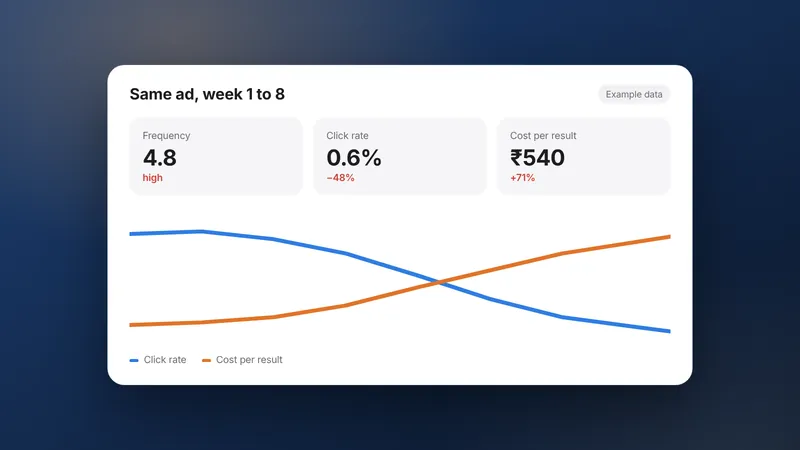
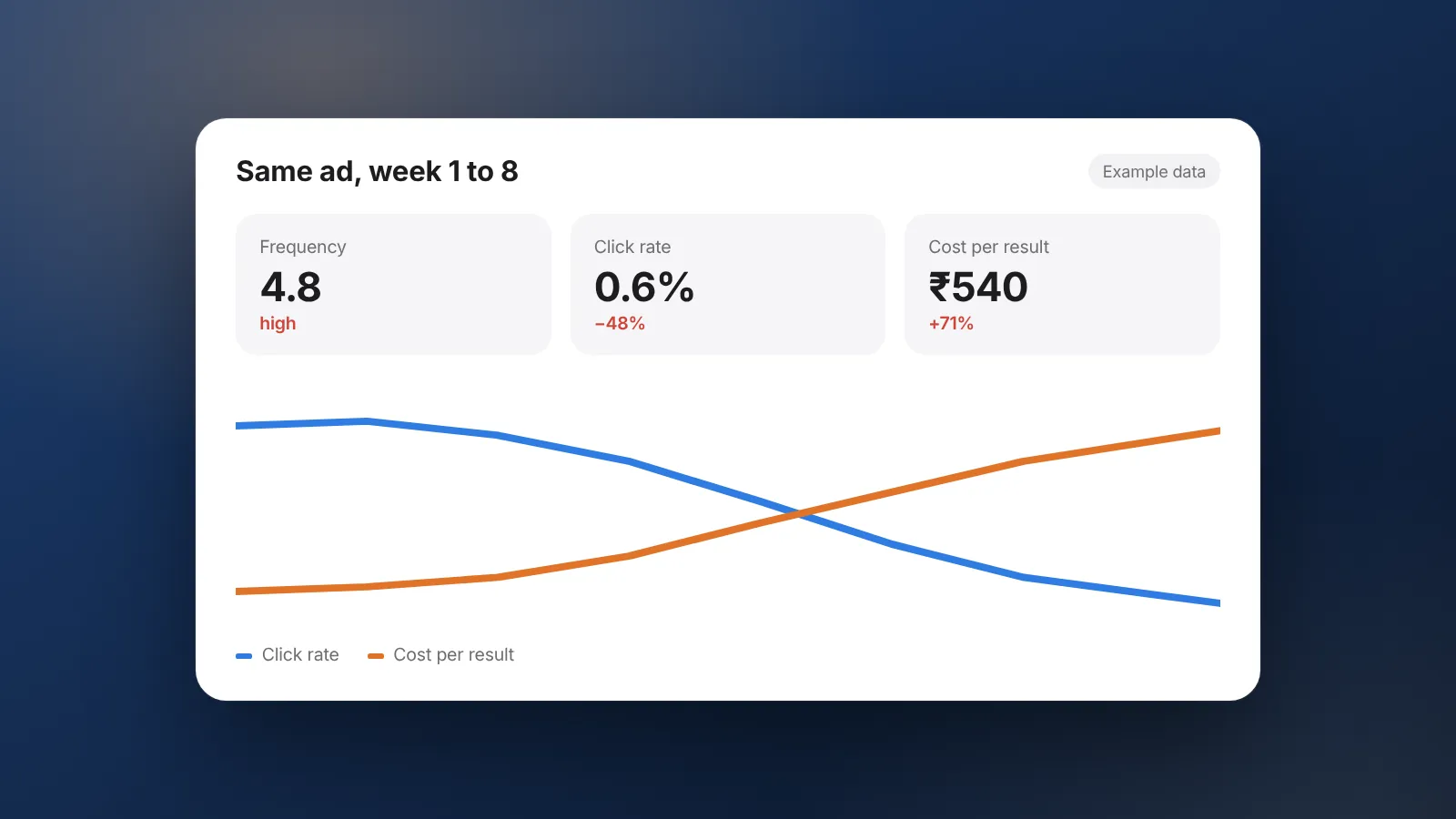
Three numbers move together: frequency goes up, click-through rate goes down, and cost per result goes up. One of them alone is not enough to call it fatigue.
| Signal | What you see in Ads Manager | Why it matters |
|---|---|---|
| Frequency rising | The average number of times each person saw the ad keeps climbing | The same people are seeing it again and again |
| Click-through rate falling | Fewer people click per thousand who see it | The ad has stopped catching attention |
| Cost per result rising | Each lead or sale costs more than it did | You pay the same to reach people who no longer respond |
| Comments turning negative | Replies like "seen this ten times" | A direct sign people are tired of it |
Look at trends over a few weeks, not day to day. Daily numbers swing too much to judge.
There are no universal frequency or click-through thresholds that mean "fatigued". Compare each ad with its own earlier weeks and with your other ads.
What causes creative fatigue?
The main cause is a small audience and too few ads. The fewer people you can reach and the fewer ads you rotate, the faster each person sees repeats.
Other causes make it worse:
- Budget increases without new creative, which push more impressions into the same audience.
- Narrow targeting, such as one small city area or a short list of interests.
- Retargeting audiences, which are small by nature and see ads very often.
- Ads that all look alike, so even a "new" ad feels like a repeat.
Seasonal offers also wear out faster. A festival discount ad has a short life, and people know it.
Is it fatigue or something else?
Check before you rebuild everything. Rising costs can come from several causes, and fatigue is only one of them.
Ask these questions first:
- Did the landing page, form or website change, or get slower?
- Did tracking break, so results are happening but not being recorded?
- Did competition rise, as it often does around festivals and sales periods?
- Did the offer, price or stock change?
If frequency is flat and click-through rate is steady, but cost per result rose, look at the page and tracking first. Our post on Meta Pixel and Conversions API setup covers the tracking checks.
Worked example (example numbers): A brand spends ₹20,000 a week on one ad set with three ads.
In week one, frequency is 1.6, click-through rate is 1.2% and it gets 50 leads, so cost per lead is ₹400.
By week four, frequency is 3.4, click-through rate is 0.7% and it gets 32 leads, so cost per lead is ₹625.
The page and tracking have not changed, so fatigue is the likely cause.
In week five it adds four new ads with new opening visuals and gets 45 leads, so cost per lead is about ₹444.
These numbers are only for illustration. They are not benchmarks, and your own will differ.
How often should you refresh creative?
Refresh on a schedule, before fatigue shows, rather than waiting for results to fall. How often depends on your budget and audience size.
A practical way to set the pace:
- Small budget, broad audience: add a few new ads every month.
- Larger budget or smaller audience: add new ads every one to two weeks.
- Retargeting: rotate more often, as the audience is small.
Keep a short log of each ad's launch date and when its cost per result started to rise. After a few months, you will know your own refresh rhythm. Our post on how many ad creatives you need each month goes into the volume question.
How should you structure creative tests?
Keep testing separate from your main campaign, change one big thing at a time, and give each test enough budget to get a clear answer.
A simple structure that works for most small accounts:
- Main campaign: your proven ads, which get most of the budget.
- Test campaign: a smaller share of budget for new ideas.
- Graduation: move a test ad into the main campaign once it beats your current ads on cost per result.
Test big differences first, such as a new angle, hook or format. A video showing the product in use against a price-led static image teaches you more than two headline variations.
Decide your success measure before the test starts. Use cost per lead or per sale, not likes or reach.
Does fatigue happen on newer channels too?
Yes. Any channel that shows the same message to the same people will wear out over time.
ChatGPT ads are a newer example. OpenAI describes them as labelled sponsored placements shown below answers, as of October 2026, in its post on new ways to buy ChatGPT ads. They launched in India in late August 2026, according to Outlook Business.
The channel is too new for clear patterns. The same habits still apply: watch frequency and response, and plan fresh creative from the start.
How do you keep a steady supply of new creative?
Plan creative like a calendar, not an emergency. Batch ideas each month, produce them in a set, and keep a few ready before you need them.
AI tools can make it practical to produce more variations quickly. If you use AI-made images or video, label them as AI-made and check Meta's current advertising policies. Our post on whether AI-generated ads are allowed on Facebook and Instagram covers this, and our AI ad studio explains how we produce them.
The WebMaxs Launch Growth plan includes 8 AI video ads a month, and Full Funnel includes 20 ad creatives a month. We run campaigns through our Meta and Google ads service. Plans and prices are on our pricing page.
Frequently asked questions
Should I turn off a fatigued ad straight away?
Not always. Lower its budget share and add new ads first, so the ad set does not lose all its delivery at once. Switch it off when the new ads are clearly doing better.
Does increasing the budget cause fatigue?
It can speed it up. More budget against the same audience means people see the same ads more often. If you scale, add new creative at the same time.
Can I bring back an old ad that worked?
Yes, after a break. Some ads perform well again months later, especially if your audience has changed or grown. Treat it like a new test and judge it on fresh numbers.
Is a small change, like a new headline, enough to fix fatigue?
Sometimes it helps for a short while. A genuinely new angle, opening shot or format usually lasts longer. People notice the visual first, so change what they see, not only the words.
Does fatigue affect lead form ads and sales ads the same way?
The pattern is the same: rising frequency, falling response and higher cost per result. How fast it happens depends on your audience size, budget and offer, not the campaign objective alone.
Sources
- OpenAI: New ways to buy ChatGPT ads (5 May 2026)
- Outlook Business: OpenAI rolls out ChatGPT ads in India (2026)
Platform rules change. Check the official pages before you launch.
Want this done for your brand?
See how WebMaxs handles Meta and Google ads, or tell us about your business and we will bring three ideas and a free sample ad to the call.